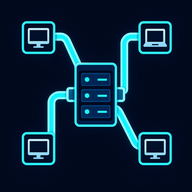
Network Puzzle
Turn each cable until every computer and laptop is connected. Then try Real mode, which works like a real network: cables split only through a switch, and routers and firewalls decide what passes.
What the game offers
One quarter turn at a time
Each cable turns a quarter turn at a time. The board is finished when the signal reaches every device from the server in the middle.
Board sizes repeat
Most boards are 7×6. Every fifth board is 8×7. Every tenth board is 9×8, and its cables also connect across the edges of the board.
Gold, silver, bronze
Each board has three time limits. Finish within one and you earn that medal. Play a board again to improve your medal.
Three lives
When the time runs out the board pauses. You can watch an ad for one extra thirty seconds, or end the attempt and lose a life. You have three lives, and one comes back every thirty minutes.
Connected cables light up
Tap a cable or a device to turn it. Connected cables light up and the devices switch on. Arcade boards also have cables that split in two or three directions.
The server is two squares high. Tapping it turns all of its ports by one position, and this counts as a move. Each port carries a colour and a line pattern, and a cable only connects to a port that matches it.
Real cables do not split
In Real mode the cables are only straight or bent, so they can split only through a device. A switch shares one network. A router connects two networks and keeps other traffic apart. A firewall lets traffic through in one direction only, so it must face the server.
Several networks can share one cable. Each network keeps its own VLAN label, so the route must be correct and the label must match.